
INDUSTRY NEWS · LED lighting emerging markets
LED Lighting Opportunities Across Emerging Markets
Treat every destination as a separate product brief rather than assuming one 'emerging market' configuration. Verify local voltage and frequency, common fittings, channel price expectations, labels, language and applicable documents. Start with a focused range and test the exact variants before making volume or profitability assumptions.Local preview · November 12, 2026 · Shieldaily Editorial Team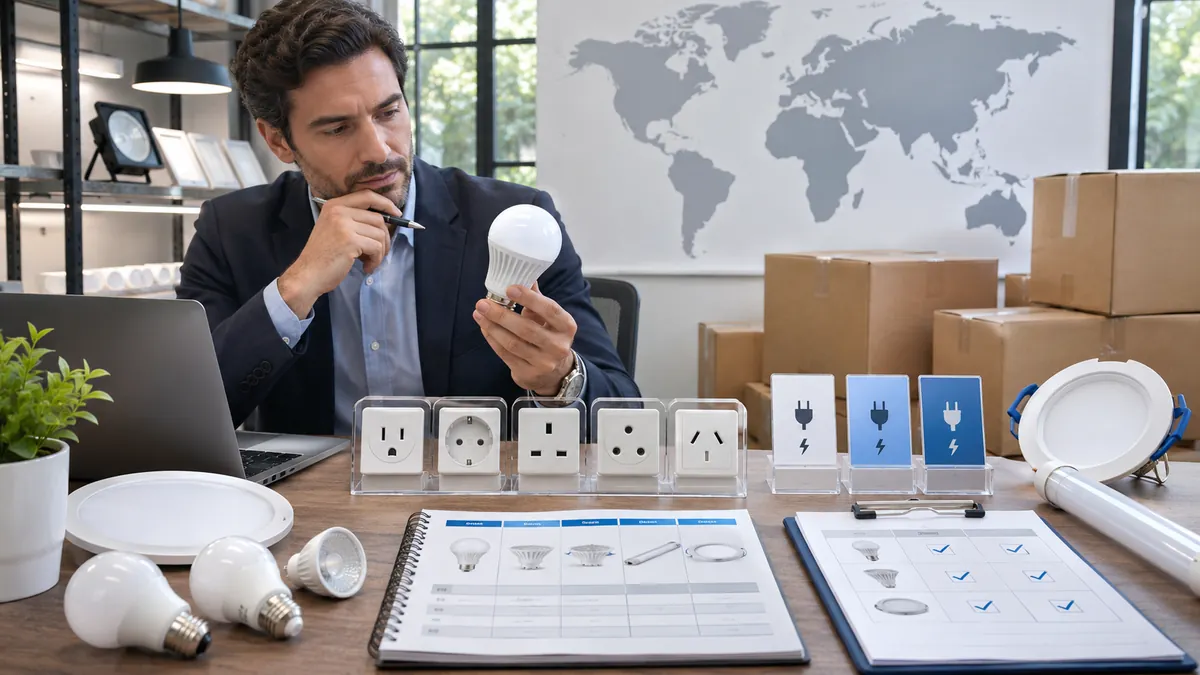
The phrase emerging markets covers countries with very different electrical systems, customer channels and purchasing constraints. A range that works in one city or retailer may be unsuitable elsewhere.
Instead of promising an opportunity size, buyers can identify a practical opening: a reliable core bulb, a remote function, a smart feature or backup operation that serves a stated customer need. Each decision should be checked against local installation and market requirements. A market-by-market sample and packaging plan is more reliable than a single export specification for every region.
Emerging Markets Are Not One Market
Define the country, sales channel, customer segment and application separately. Collect local feedback on fittings, desired light and product support needs. Do not assume a regional label predicts demand, certification or price. A distributor may start with one practical SKU and expand only after the first sample and market response are understood.
Plan the market or application: Market planning
Voltage and Frequency
Record the supply format for the destination and inspect the offered bulb's label. A wide-voltage claim must apply to the selected model, not a nearby listing. Frequency and any relevant plug, driver or control requirement should be reviewed for the actual product. Keep electrical variants distinct in the warehouse and quotation.
Lamp-Base Preferences
Check the fittings customers actually use. E26, E27, B22, E14, GU10 and other formats may coexist in a market. Choose variants from observed demand and fixture access rather than using one base for an entire region. Test fit on representative sockets and identify the base clearly on packaging.

Basic, Remote, Smart and Emergency Products
Select functions with a defined use and support route. A basic replacement may suit a channel with little setup support; a remote or smart model adds a control journey; an emergency bulb adds battery and switch instructions. Compare what the customer gains against the complexity the distributor must explain.
Related buyer guide: Wholesale bulb guide
Price and Product Positioning
Set a target selling role and then compare complete product configurations at the same quantity. A bare lamp, controller set and private-label retail pack have different costs. Do not infer margin or sales volume from an industry article. Use channel feedback and actual quotations to assess commercial fit.
Packaging Languages
Choose the languages the channel and destination require. Explain base, voltage, controls and operating steps in a way the end user can follow. Smart setup or emergency switch instructions can be critical. Approve printed materials against the tested sample before ordering cartons.
Compliance and Labelling
Identify current local obligations for the exact product and economic operator. Ask for model-specific records and check rating labels, radio equipment and energy information where relevant. Do not present a CE or FCC document as universal market approval. The buyer should verify rules with authoritative local sources before launch.
Plan the market or application: Distributor solution
Building a Range Through Sample Testing
Start with a small set of differentiated SKUs and a test plan for each. Check electrical fit, light output, controls and pack contents under conditions representative of the market. Record what customers or installers report, then adjust the range. This is more defensible than launching many variants on generic supplier descriptions.
FAQ
Frequently asked questions
Is there one LED bulb specification for all emerging markets?
No. Electrical format, fittings, language and obligations differ by destination and channel.Should a distributor begin with smart bulbs everywhere?
No. Choose the control experience customers need and the channel can support; a basic or remote product may be a better first option.Can this article predict sales or profit?
No. It provides a product-selection framework, not a market-size or return forecast.Why test a local fitting?
It confirms the actual base, voltage and physical installation rather than relying on a regional assumption.RELATED RESOURCES
Continue your product review
The Next Stage of LED Lighting: Smarter, More Efficient and Longer-Lasting
An evidence-conscious look at LED product direction: useful efficiency, controls, reliability, packaging and how buyers should compare ranges.Read articleLED Efficiency Is Moving Beyond Wattage Reduction
Compare LED system efficacy, useful light, driver and thermal behaviour, controls and operating life instead of focusing on watts alone.Read articleWhat EU Light-Source Rules Mean for LED Bulb Importers
A buyer-oriented overview of EU light-source ecodesign, energy labels, EPREL and the separate checks needed for CE, RoHS and radio products.Read articleHAVE A PRODUCT IN MIND?
Discuss the Requirement for Your Market
Tell us the destination market, product type and question raised by this topic. We can review a relevant model and the information needed for your buying decision.